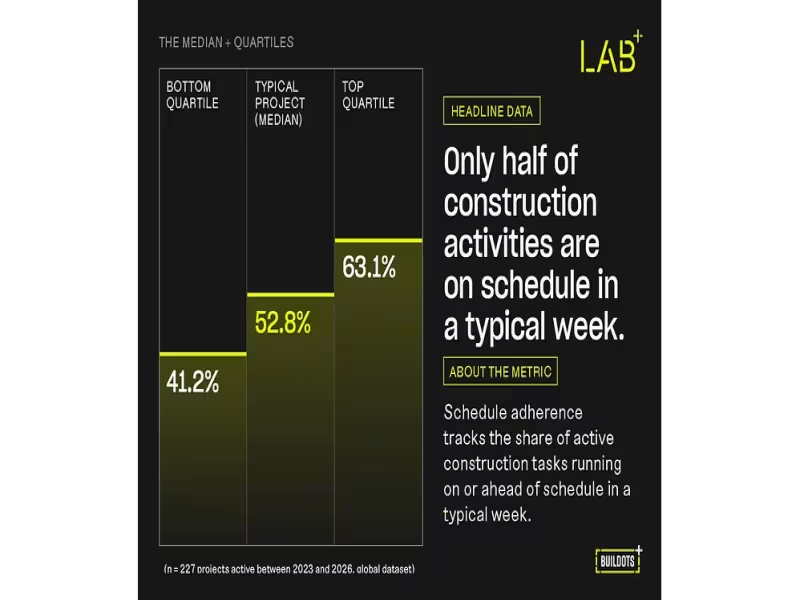
Global – – October 08, 2026 -- Nearly half of all active construction work runs behind schedule in a typical week, with sites keeping only 52.8% of activities on track, according to a new benchmarking report from the Buildots Intelligence Lab. The report, the first in an ongoing research series, measured 21 core construction activities to establish what it calls construction's first objective, data-driven performance baseline.
Projects deliver just 63% of planned weekly output
The typical construction project completes only 63% of its planned weekly output, leaving 37% of planned work volume undelivered. Of the 21 activities tracked, 20 fell short of plan, ranging from 38% delivery on resilient and soft flooring to drywall framing, the sole activity that exceeded its target at 122%.
Average activities finish 5.3 weeks late, but top performers cut delays to 2.3 weeks
The report found a sharp performance gap between typical and top-quartile projects. While the average construction activity finishes 5.3 weeks behind schedule, top-quartile projects contain that overrun to 2.3 weeks, indicating that faster, more reliable delivery is achievable within existing industry conditions.
70.7% of activities miss their planned start date
Just 29.3% of construction activities begin on time, the data shows, underscoring schedule slippage as a recurring industry-wide issue rather than an isolated project risk.
Lab plans sector-specific editions covering data centers and healthcare
Having established a global baseline, the Buildots Intelligence Lab said it will next apply the same methodology to sector-specific and regional editions, starting with data centers and healthcare, to produce benchmarks project teams can be held to directly.
"Everything else that goes into a building has long been standardized – equipment, materials, specs. But one thing that hasn't been is the work itself," said Amir Berman, VP of Industry Transformation at Buildots and head of the Intelligence Lab.
Roy Danon, Co-founder and CEO of Buildots, said the findings demonstrate that strong performance already exists across the industry but remains inconsistent, framing the benchmarks as a first step toward helping construction organizations perform more predictably at scale.