
X-Bow Systems

Leidos Taps X-Bow for Army Low-Cost Cruise Missile Rocket Motors
Image
Leidos Taps X-Bow for Army Low-Cost Cruise Missile Rocket Motors

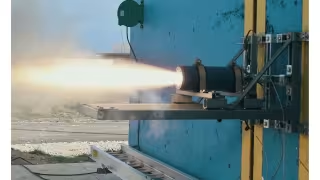
Washington – October 12, 2026 -- Leidos (NYSE: LDOS) has selected X-Bow Systems to develop and produce the booster motors for the U.S. Army's Low-Cost Containerized Munition (LCCM), with full-rate production at scale planned for 2027. X-Bow announced the award at the Association of the United States Army (AUSA) Annual Meeting and Exposition.

X-Bow enters design, qualification and static-fire phase ahead of 2027 production

Under the agreement, X-Bow will move through design, qualification testing and static fires before ramping to full-rate output. Leidos will produce the munitions in large quantities.

LCCM advances the Department of War's "Arsenal of Freedom" initiative

The award places X-Bow in one of the fastest-growing segments of U.S. defense spending: rebuilding a domestic solid rocket motor industrial base long concentrated among a handful of large suppliers, and fielding precision munitions in volume.
X-Bow Wins Nearly $70M Navy Deal for Next-Gen Missile Booster

Image
X-Bow Wins Nearly $70M Navy Deal for Next-Gen Missile Booster

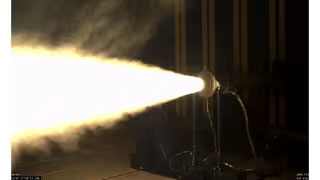
Albuquerque, N.M. – October 07, 2026 -- X-Bow Systems has secured a prototype agreement worth up to $69.7 million to develop and qualify a solid rocket motor booster for a U.S. Navy next-generation weapon program targeting surface warfare threats.

Pentagon funds phased development with $50 million obligated upfront

The agreement, administered by U.S. Army Contracting Command – Rock Island, splits into a $50.4 million Phase 1 development effort and a $19.3 million Phase 2 qualification option. Of the total, $50 million has been obligated at award to fund a 12-month Phase 1 timeline.

Navy targets early FY 2031 fielding of common interceptor architecture

The program replaces single-purpose interceptors with a shared architecture, including variants designed to pack more interceptors into each launch system. The Navy expects an initial operational capability in early FY 2031.