AppsTek

Oracle AI Database Migration Turns Into an Architecture Decision

Image

Oracle AI Database Migration Turns Into an Architecture Decision

Global – October 29, 2026 -- Oracle AI Database can now run across five environments: OCI, AWS, Microsoft Azure, Google Cloud, and supported on-premises setups. It can also run on Oracle-managed infrastructure inside the customer data center. Migration is therefore an architecture decision before it is a data-movement exercise, according to guidance from Oracle services provider AppsTek.

Agentic Search Lifts Inference Costs 3-5x as Enterprise Gaps Persist

Image
Agentic Search Lifts Inference Costs 3-5x as Enterprise Gaps Persist

Global – October 29, 2026 -- Some 34 percent of employees still struggle to find the information they need to do their jobs, according to Gartner's Market Guide for Enterprise AI Search, published in September 2025. Enterprises are now rearchitecting search around retrieval-augmented generation (RAG) and agentic AI, a shift that can multiply inference costs by three to five times at scale.

Gartner finds 36 percent of AI tool users still cannot access relevant information

Roughly 49 percent of workers now rely primarily on AI tools such as Copilot or Gemini for data discovery rather than traditional search interfaces. Yet 36 percent of those users still report difficulty reaching relevant information.

Gartner: Half of GenAI Pilots Die Before Production

Image
Gartner: Half of GenAI Pilots Die Before Production

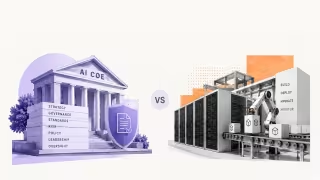
Global – October 29, 2026 -- Roughly 50% of generative AI proof-of-concept projects will be scrapped before reaching production, according to Gartner. Enterprises are responding with a two-function operating model that pairs an AI Center of Excellence (CoE) with an AI Factory.

Unclear ownership, not model quality, drives the failures

The causes are rarely the models themselves. Unclear ownership, inconsistent governance, fragmented data and the lack of a repeatable path from prototype to deployed system stall most projects, according to AppsTek, the IT services provider that published the framework guide.

Enterprises Weigh Sovereign LLMs as EU AI Act Deadline Nears

Image
Enterprises Weigh Sovereign LLMs as EU AI Act Deadline Nears

Europe – October 27, 2026 -- Self-hosted LLM infrastructure tends to become the cheaper option above roughly 50 million tokens processed per day, while commercial APIs usually stay more economical below 5 million, according to AppsTek's analysis of when enterprises need a sovereign LLM. The figures are illustrative and should be checked against current provider pricing and actual workload patterns.

AppsTek's third piece in its sovereign AI series argues that the model layer is now a governance decision, not only a technology choice, as generative AI moves into regulated, revenue-bearing workflows.

Agentic QE Targets Testing Unit Costs as GenAI Pilots Hit 89%

Image
Agentic QE Targets Testing Unit Costs as GenAI Pilots Hit 89%

Global – October 27, 2026 -- Some 89% of organizations surveyed for the World Quality Report 2025 are piloting or deploying GenAI-augmented Quality Engineering (QE), but only 15% have reached enterprise-wide implementation. Respondents reported an average productivity gain of 19%. Vendors such as AppsTek are pitching agentic QE as a way to hold down testing unit costs as release volumes grow.

Maintenance work pushes up the cost of enterprise test automation

Each release adds workflows, integrations and regression paths while QE budgets stay tightly controlled. The pressure shows up in maintenance, contractor spend, rework and cost per release.

AI Agent Testing Must Cover Execution Paths, Not Just Answers

Image
AI Agent Testing Must Cover Execution Paths, Not Just Answers

Global – October 27, 2026 -- Two AI agent runs can return the same correct answer while carrying very different operational risk, which makes output-only checks insufficient for enterprise Quality Engineering (QE), according to a new AI agent testing framework built around four evaluation layers.

Recovered failures can look like clean successes

In the source's example, an agent retrieving an account balance queries an unnecessary privileged system, hits an authorization error, retries twice and then reaches the approved source. The user sees a correct result. An output-level assertion marks the run as a success, while a trace-level evaluation flags it as degraded.