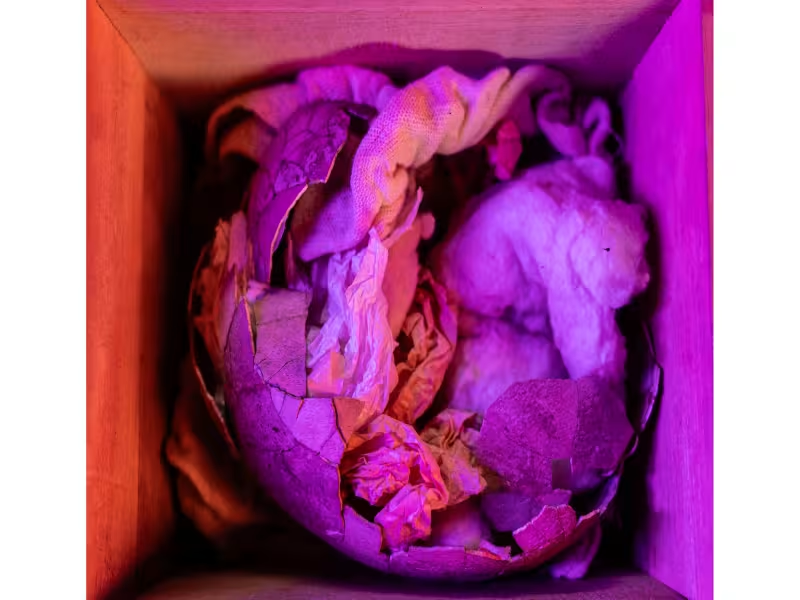
Christchurch – October 19, 2026 -- Colossal has bought a giant moa egg from Artemis Gallery in Louisville, Colorado, and will return it to New Zealand for care under the Ngāi Tahu Research Centre, with a repatriation ceremony planned for December.
The egg was found in New Zealand on January 14, 1966, and spent roughly six decades in a private American collection before it resurfaced at public auction. Auction records indicate it may come from a Moa Hunter-period burial site dating to around AD 1300. Further research is needed to confirm that provenance.
Fewer than 40 sufficiently complete moa eggs exist in public collections
Only eight of those retain at least 90 percent of their original shell. Te Papa describes its own egg as one of 36 mostly intact moa eggs worldwide. A 2005 survey by ornithologist Brian Gill counted 33 eggs complete enough to measure. Gill found all known eggs in public collections: four at London's Natural History Museum and the rest in eight New Zealand institutions.
The newly documented egg is not among those counted. It measures about 22 by 17 centimeters, roughly 1.5 times the length and nearly double the volume of an ostrich egg. It has been reconstructed from many fragments, and more remain to be reattached under the guidance of Ngāi Tahu researchers.
Film director Sir Peter Jackson said restoration would very likely make it only the ninth known nearly intact moa egg, and probably one of the five best-preserved.
New Zealand law did not cover the egg's export
Under the Protected Objects Act 1975, intact moa remains cannot be exported without permission from the Ministry for Culture and Heritage. The egg left the country before the law took effect. Colossal says it bought the egg after seeing it listed and will fly it to New Zealand by private transport. Jackson said Colossal offered to rescue it at its own considerable expense.
Ngāi Tahu will decide on DNA and isotope testing
Possible work in New Zealand includes non-destructive imaging and sampling for DNA or isotopes to confirm species and geographic origin. The Ngāi Tahu Research Centre will decide whether and when to proceed, in accordance with tikanga. Published research has already recovered ancient DNA from moa eggshell fragments.
Colossal Chief Science Officer Beth Shapiro said each whole egg "holds information we can get nowhere else."
Moa program partnership dates to 2025
Colossal, the Ngāi Tahu Research Centre, Jackson and Canterbury Museum launched the moa de-extinction program as a joint initiative in 2025. Scientists have worked with Ngāi Tahu archaeologist Kyle Davis at cave and subfossil sites across Te Waipounamu to collect samples for sequencing the genomes of multiple moa species. In May 2026, Colossal hatched healthy chicks in a shell-less artificial incubation system designed to eventually support eggs approaching moa size.
Colossal says it has committed to open-sourcing the conservation technologies it develops, under partner guidance. Its plans include biobanking taonga species across the Ngāi Tahu takiwā and building biotechnology capability toward future Colossal Laboratories in New Zealand.
Announcement opens SAPE 2026 in Christchurch on October 19
The repatriation will be announced on Monday, October 19, 2026, the opening day of the 11th International Meeting of the Society of Avian Palaeontology and Evolution. The meeting runs through October 23 at the Christchurch Town Hall. Canterbury Museum's Dr. Paul Scofield, a collaborating scientist on the moa program, sits on the organizing committee.