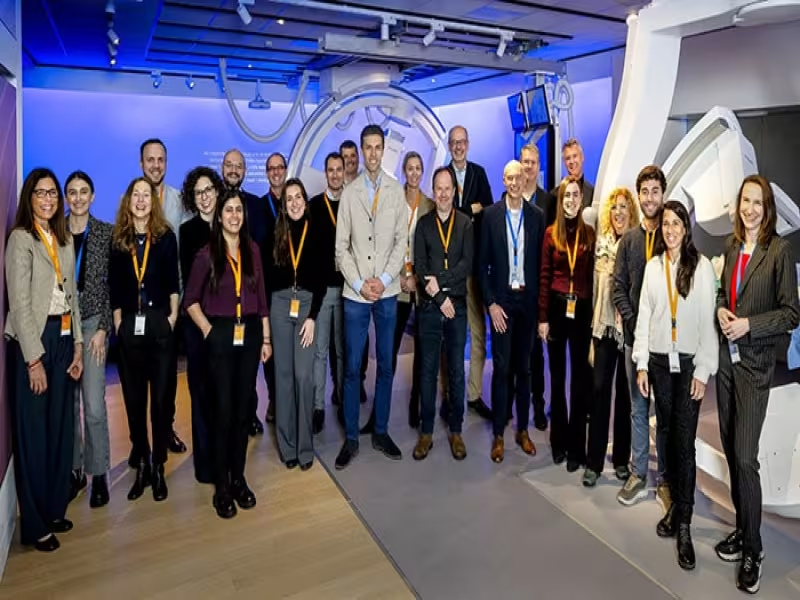
SHERIDAN, WYOMING - March 31, 2026 - European hospitals evaluating 2026 imaging, intervention, and workforce plans now have a new validation pathway for AI-assisted neurovascular and oncology procedures as the SHERPA consortium starts seven clinical studies focused on workflow automation, precision support, and staff-pressure reduction in minimally invasive care. The four-year project has a total budget of EUR 21.5 million, is coordinated by Philips, and is co-funded by the EU Innovative Health Initiative and industry partners. Its work targets minimally invasive treatment workflows for brain aneurysms, liver tumors, and lung biopsy settings where specialized expertise is limited and procedure complexity is high.
Clinical scope
The clinical studies are being run at University Medical Center Utrecht, St Antonius Hospital, University Medical Center Hamburg-Eppendorf, Hôpital Bicêtre AP-HP, and Hospital de la Santa Creu i Sant Pau. The consortium includes 16 partners from seven European countries, spanning five medical technology companies, five academic partners, and five research organization and medical association partners. Industry participants named in the project are Philips, Medtronic, Sim&Cure, Interventional Systems, and Barco.
Five studies are dedicated to brain aneurysm care: RADAR for AI-based aneurysm detection using CT and MR imaging; Aneurysm@risk for predicting aneurysm growth and rupture risk; ASSIST for device selection and positioning guidance; INTERACT for automatic collimation and projection angle suggestions during procedural imaging; and SAFO for digital remote follow-up and standardized monitoring. Two additional studies extend the program into oncology workflows: MISTRAL evaluates new Cone Beam CT workflows for percutaneous liver ablations, while RHODES compares robotic-assisted and free-hand lung biopsies with attention to operability and device efficiency.
Technology and validation path
SHERPA is focused on AI-powered technologies in imaging, data visualization, procedure planning and guidance, clinical decision support, and patient pathway orchestration. The consortium says these tools are intended to automate repetitive and time-consuming tasks, support physician decisions, and shorten learning curves for interventional radiologists and interventional neuroradiologists. The stated objective is not a single standalone device, but orchestrated end-to-end workflows that connect multiple assistive functions across diagnosis, treatment planning, procedure execution, and follow-up.
During the first project year, the consortium developed AI algorithms to identify brain aneurysms that need treatment and algorithms for patient selection and therapy planning in liver tumor ablation. It also developed robotic technology aimed at improving procedural precision and reducing difficulty, plus AI software to confirm treatment success. Those components have now been integrated into workflow packages for brain aneurysm repair and liver tumor ablation, and the next three years of the project are set aside for clinical refinement and assessment of patient experience, workload optimization, interventionist satisfaction, and performance.
Business impact
Procurement leads and imaging-service line directors gain a more concrete basis for 2026 vendor evaluation because SHERPA is testing workflow combinations rather than isolated algorithms. That matters for capital planning in angiography, cone beam CT, navigation, robotics, and follow-up software, where hospitals increasingly need evidence that tools improve operability, standardization, and clinician workload before expanding platform commitments. The named studies also show where product categories may move first: aneurysm detection and planning, procedural imaging optimization, liver ablation workflow support, and robotic biopsy assistance.
Clinical operations directors and workforce planners face a separate decision path: whether automation can offset shortages in highly trained interventional specialists without reducing care coordination. SHERPA directly addresses that pressure by targeting routine task automation, decision support, and training acceleration in procedures that rely on advanced imaging and precise device placement. For European health systems, the EU-backed IHI funding structure and multi-country hospital participation increase the relevance of the results for regional adoption, cross-border evidence review, and compliance discussions tied to future deployment of AI-enabled interventional tools. Suppliers and hospital innovation teams should watch which study endpoints show measurable gains in workflow efficiency, physician satisfaction, and treatment confirmation, because those outcomes will influence 2026 roadmap prioritization and partnership decisions.