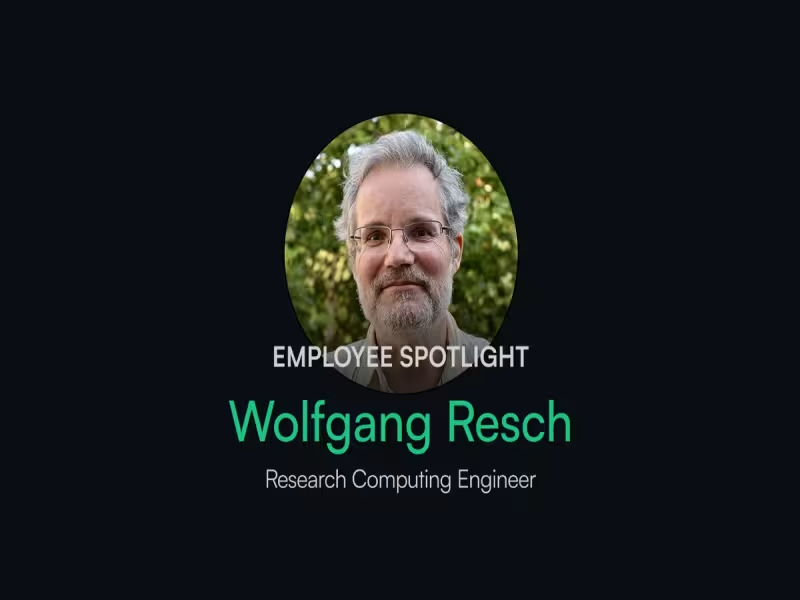
United States – October 12, 2026 -- CIQ's Fuzzball 4.2 allows AI agents to interact with the HPC platform within permissions set by the customer organization, and lets workflows submit and manage other workflows. Research Computing Engineer Wolfgang Resch, who spent roughly a decade supporting researchers at the NIH High Performance Computing facility, says the agent access will lower the barrier to entry for new users and speed development of Fuzzball workflows.
Fuzzball 4.2 adds agent access and workflow-to-workflow submission
Resch sees opportunities to fold Fuzzball into existing agentic workflows and to help administrators investigate cluster issues. Workflows that launch other workflows enable more complex applications and simplify integration with workflow engines such as Nextflow.
Fuzzball combines familiar HPC concepts with container-based ideas. Teams define portable workflows covering jobs, services, resources, code and containers, which can run across local infrastructure, traditional schedulers and cloud resources.
Arcee AI uses Fuzzball to coordinate workloads across dispersed compute
Arcee AI, developer of the open weight Trinity model family, runs selected workloads on Fuzzball across dispersed computing resources while keeping its existing training and inference stack. Feedback from Arcee's team has helped CIQ develop a new way to incorporate dispersed and otherwise disconnected resources into Fuzzball clusters.
NIH experience shapes the platform's design goals
Resch holds a biochemistry doctorate from the University of North Carolina at Chapel Hill. He moved from HIV drug-resistance research to bioinformatics at the National Center for Biotechnology Information and the National Institute of Arthritis and Musculoskeletal and Skin Diseases, as high-throughput sequencing pushed data volumes up. At NIH HPC he adapted open source tools for the cluster, taught workshops and worked across storage, scheduling, system administration and cloud.
That work left him with two principles: research computing should be accessible to people with less infrastructure expertise, and administrators need enough control to protect a shared environment. Interactive computing, persistent services and containerized applications were hard to add to environments built around batch jobs.
At CIQ, Resch deploys Fuzzball for customers and partners, collects feedback, adds applications and builds integrations with external tools. "Supporting research computing does contribute to scientific research directly," he says.