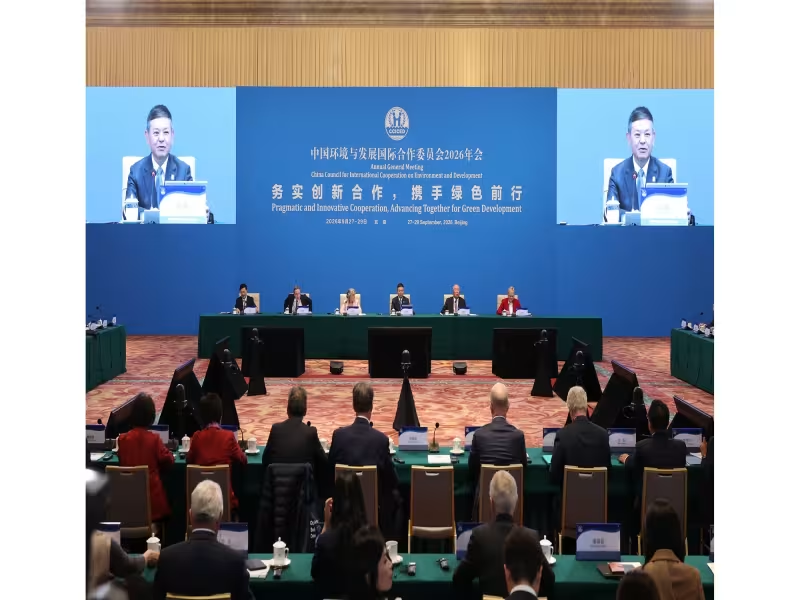
Beijing – – September 30, 2026 -- Global climate officials meeting in Beijing this week pressed for faster international cooperation on clean energy, pointing to China's build-out of what they called the world's largest clean power and clean steel production systems as a template for coordinated industrial policy.
China reports ultra-low-emission retrofits across 1.17 billion kilowatts of coal power capacity
Huang Runqiu, China's minister of ecology and environment and executive vice-chairperson of the China Council for International Cooperation on Environment and Development (CCICED), said the retrofits extend to 990 million metric tons of crude steel production capacity. He added that China now operates or has under construction 101 nuclear power units, the largest such pipeline globally. The figures were presented as evidence of tangible emissions-cutting action rather than policy commitments alone.
CCICED's three-day annual meeting opened under the theme of pragmatic, innovative cooperation
The gathering, themed "Pragmatic and Innovative Cooperation, Advancing Together for Green Development," is producing policy recommendations through joint research involving international advisers. Julie Dabrusin, Canada's minister of environment and climate change and CCICED international executive vice-chairperson, described the council as the cornerstone of bilateral China-Canada environmental cooperation, citing progress in clean electricity grids, methane reduction and nature conservation on the Canadian side. She noted that CCICED research on plastics and circular economy feeds directly into the ongoing negotiations for a legally binding global plastics treaty.
Former UN official says China's environmental code and five-year plan merge growth with sustainability
Achim Steiner, former administrator of the United Nations Development Programme, pointed to China's Ecological and Environmental Code, which took effect on Aug. 15, and the 15th Five-Year Plan (2026-30) as evidence of a synergistic agenda linking environmental and economic policy. Kristin Halvorsen, former director of Norway's CICERO Center for International Climate Research, said the five-year plan translates climate commitments into coordinated actions across government agencies, calling China's experience an industrial strategy as much as an environmental necessity. She added that international cooperation on climate has become a strategic requirement rather than a discretionary pursuit amid a fragmented geopolitical landscape.
Former climate envoy warns against unilateral approaches to global green transition
Xie Zhenhua, China's former special envoy on climate change, called on the international community to strengthen confidence in implementing nationally determined contributions and cautioned against unilateralism. He said the council should continue functioning as a bridge between China and other governments in navigating geopolitical tension while advancing the global green transition.