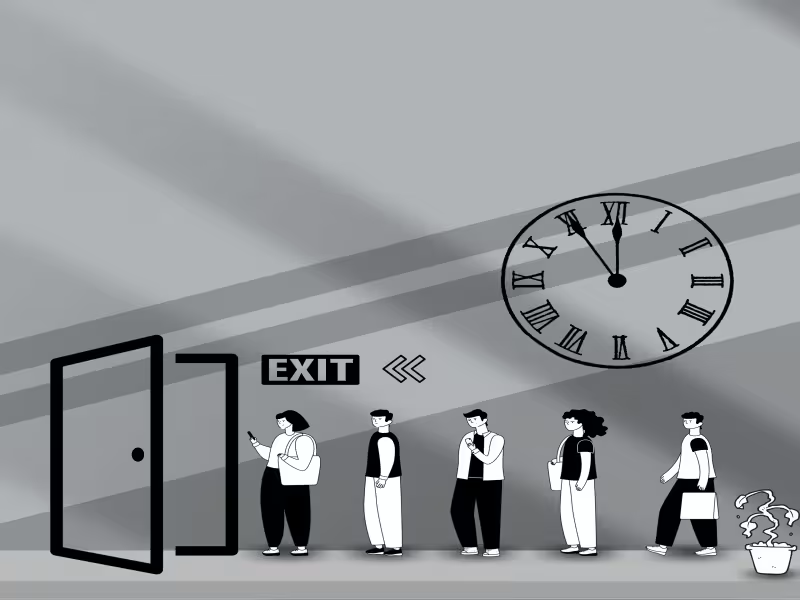
SHERIDAN, WYOMING — July 03, 2026 — Bonner Wirtschafts-Akademie (BWA), a Bonn-based personnel development and outplacement consultancy, has warned that Germany faces job losses of historic scale as an energy cost crisis and rapid AI adoption compound one another. BWA managing director Harald Müller pointed to a recent survey from the Institute of German Economy (IW), which found companies plan to cut nearly 30 percent of positions this year, calling that figure only the starting point of a larger shift. He argued the combination of rising energy costs and AI-driven automation will eliminate hundreds of thousands of jobs across both industrial and office roles, layered on top of losses already underway in the automotive sector.
BWA Defines the "AI Crisis" as a Structural Shift, Not a Trend
BWA uses the term "AI crisis" to describe two parallel developments: the rapid replacement of office work by AI systems and the coming replacement of industrial roles by a next generation of humanoid robots. Müller frames this as distinct from earlier waves of automation because it touches white-collar and blue-collar work simultaneously, rather than concentrating job losses in manufacturing alone.
US Executive Survey Signals What Germany Could Face Next
Müller cited a survey of roughly 1,000 CEOs in the United States, conducted by consulting firm Mercer, in which 99 percent expected personnel cuts tied to artificial intelligence. Those executives estimated that about half of current work output in their companies is produced entirely without AI assistance. They projected that share would fall to roughly 35 percent in the coming years as AI adoption advances and associated staff reductions take hold. Of the jobs that survive the resulting streamlining, Müller said, two-thirds would be equipped with AI tools rather than continuing unchanged. He expects a comparable pattern to emerge in Germany.
Workforce Anxiety About AI Is Climbing Sharply
Data from the Global Talent Trends 2026 report, based on responses from roughly 12,000 participants including both executives and HR staff, shows employee concern about AI rising quickly. The share of employees who described themselves as threatened by artificial intelligence grew from 28 percent in 2024 to 40 percent in the current survey. Müller said this fear factor is widely underestimated inside companies, based on his own conversations with HR leaders. He described a pattern of passive resistance building within workforces, driven by concern that employees could be automating themselves out of their own roles — resistance he said more often derails AI projects than any technical limitation does. He pointed to transparent communication, structured workplace training, and active involvement of affected employees as the conditions that determine whether an AI rollout succeeds.
Müller Calls for Political and Union Involvement, Not Resistance
Müller urged policymakers and labor unions to help shape the AI-driven transformation of work rather than leaving the process entirely to companies, arguing that the scale of the coming labor market impact demands a political response. His advice to unions was to engage with the transformation proactively rather than resist it, warning that a purely defensive posture would not succeed. He argued that delaying AI adoption in German industry would ultimately hurt the competitiveness of domestic companies and lead to even greater job losses over time.
Demographic Shortfall Complicates the Picture
Müller framed part of the challenge as balancing job losses from AI against a separate, older problem: an aging workforce. He noted that nearly 20 million baby boomer employees are expected to leave the workforce by 2036, while only about 12 million younger workers are positioned to replace them. In his view, AI offers a way to offset that looming labor shortfall without losing productivity. At the same time, he cautioned that Germany's high energy costs are pushing manufacturing activity abroad at a pace AI development cannot offset — a trend he said actually intensifies the labor market impact rather than easing it.
Joint Study Points to Humanoid Robots Taking on Physical Work
A separate study conducted by BWA together with the IG BCE union examined the rise of "Physical AI" — humanoid robots capable of taking over physical tasks in workplaces. Among employer and employee representatives surveyed, 62 percent expect humanoid AI robots to eventually plan and carry out workplace tasks independently, and more than a third of respondents expect that shift to arrive within the next ten years.