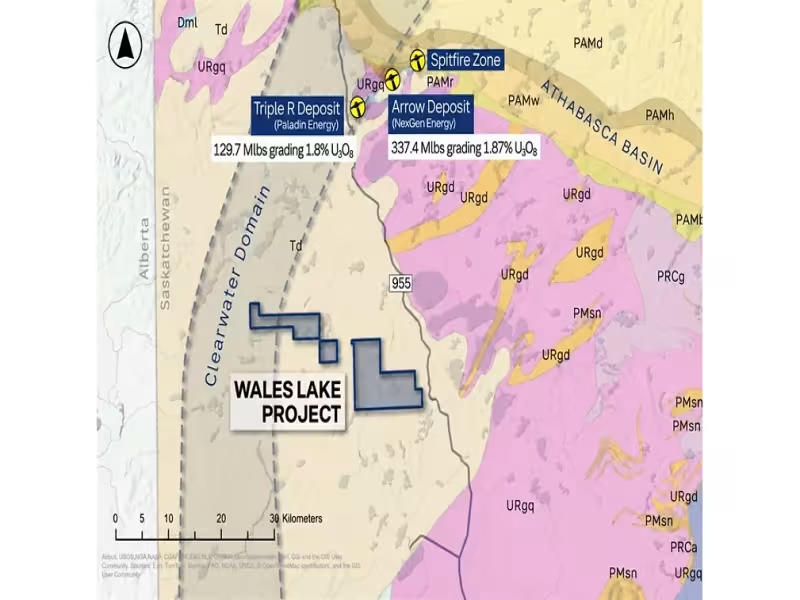
Vancouver – September 19, 2026 -- Blast Resources Inc. (CSE: BLST, FRA: O0E, OTCQB: BLSRF) has identified a prominent tectonic break extending roughly 10 kilometres through its Wales Lake, Brazier South and Britts Lake claim groups, a structural feature the company says could host uranium-precipitating fluid pathways.
Tectonic break spans claims MC00016517 to MC00016514
The northwest-to-southeast trending break sits in bedrock, buried beneath surface cover, and runs through the Wales Lake Uranium Project claims east of the Clearwater Domain. The property lies within the Patterson Lake Corridor, the same regional setting hosting Paladin's Triple R deposit and NexGen's Arrow deposit.
Structure aligns with 2024 magnetic survey and historical EM data
The break coincides with a magnetic low anomaly detected in a 2024 magnetic survey completed on the property and runs roughly parallel to electromagnetic conductors mapped by a historical VTEM survey. Blast notes that EM conductors coincident with magnetic lows are typically interpreted as graphitic faults in the Athabasca uranium model -- structures that can create reducing conditions and accommodation space needed to trap and precipitate uranium.
CEO cites exploration opportunity across two claims
"The tectonic break extends through two of our claims, providing the Company with ample opportunity to further explore its potential," said Casey Forward, Chief Executive Officer and Director of Blast Resources. He added the company plans to advance exploration in the coming months.
Blast attributes the region's uranium potential partly to radiogenic heat from granitic rocks in the Clearwater Domain, which geological research suggests may have sustained prolonged hydrothermal fluid circulation along structural corridors, mobilizing and concentrating uranium. The company positions the interpreted break as a focal point for continued geophysical and geological work at Wales Lake.
The technical disclosure was prepared and approved by Andy Yackulic, P.Geo., a Qualified Person under National Instrument 43-101.