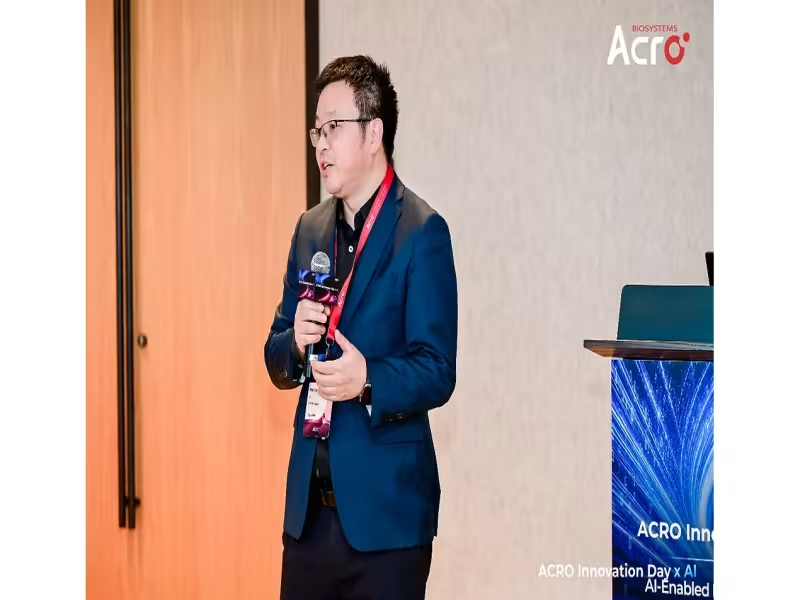
South San Francisco – October 19, 2026 -- ACROBiosystems unveiled a 4-day sequence-to-affinity screening service, CHO-DirectTM, at its ACRO Innovation Day x AI on October 13, 2026, targeting the experimental validation bottleneck in AI-driven biologics discovery. The service closes the wet-lab loop in as few as 7 days when combined with developability and characterization work.
CEO Mike Chen told attendees at The Hangar that the company's customer base has grown to 13,000. He cited rising investor interest in AI-driven drug discovery as the backdrop for the event, which followed sessions in Zurich, Shanghai (May) and a September launch event.
CHO-DirectTM delivers supernatant screening in four days
Ting Wu, Vice President of Business Development, said the service uses ACROBiosystems' protein and antibody CHO expression system. Researchers can assess expression and binding early, then advance selected candidates to functional and developability testing within the same system. Wu described a modular design in which teams choose their validation depth, with traceable data that retain negative findings alongside successful results.
AIDD-Ready portfolio links target proteins to functional assays
Dr. Yu Sun, Vice President of Product Development, presented a portfolio spanning membrane proteins, TR-FRET solutions and cell-based systems. The formats let researchers move from confirming molecular binding to testing whether a candidate recognizes the correct protein conformation, modulates the intended interaction and triggers a functional cellular response.
ACRO Direct targets training-data quality with four customer benefits
John Yuan, Vice President of Digital Solution and General Manager, presented ACRO Direct, a platform built to make experimental data easier for AI drug discovery teams to trust and reuse. The four benefits he outlined:
- More reliable training data, by separating confirmed negatives from untested or unevaluable candidates.
- Traceable results, linking measurements to curves, records and batch quality information.
- Less manual data preparation, through structured data and API access.
- Faster iteration, through shared reports for experimental and computational teams.
Panelists flag scarce antigen–antibody structures and discarded negative data
The first panel, moderated by Wu, included speakers from Onava, ARLAN Biotech, Triant Biosciences and DeepAdapt. Participants cited scarce antigen–antibody complex structures and discarded negative results as gaps in standardized training data. They said repeat testing and cross-laboratory calibration of multiple properties on the same molecule can expose trade-offs among affinity, specificity and developability. They argued that success should be measured beyond binding hit rates.
Second panel puts reproducible, machine-usable feedback at the center of loop-closing
Moderated by Larry Yu, Senior Director of Sales, the second panel featured Chris Silva of Carterra, Dr. Hong Tan of Gator Bio, David Sheehan of Nucleus Biologics and Dr. Sun. Sun warned that unreliable results can misdirect model learning. Silva stressed multi-parameter measurement and control of assay artifacts. Tan said analysis and interpretation remain potential bottlenecks even when data are reliable, and he envisioned autonomous laboratories. Sheehan highlighted reproducible culture and manufacturing conditions and AI's potential to anticipate production failures, with automation expanding into manufacturing.