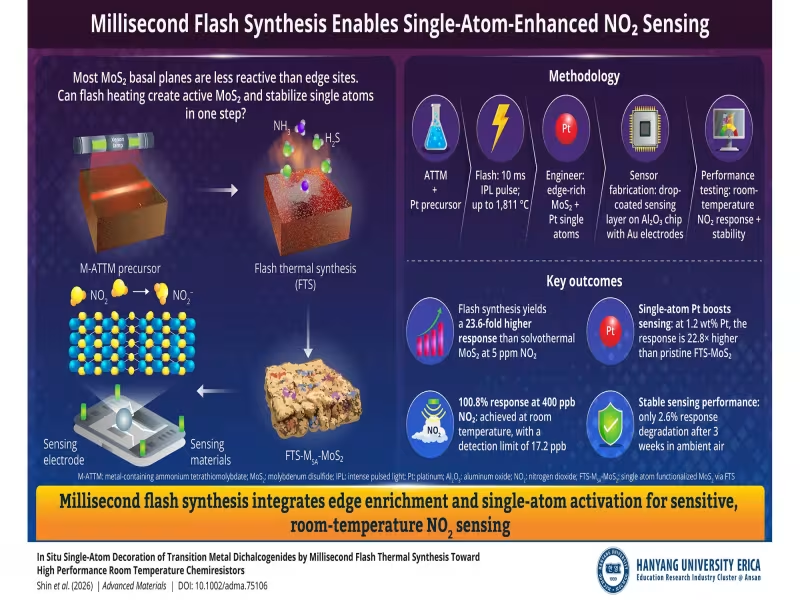
ANSAN-SI, South Korea – October 30, 2026 -- A single 10-millisecond light pulse produced molybdenum disulfide (MoS2) gas-sensing material with a 23.6-fold stronger response to 5 parts per million of nitrogen dioxide (NO2) than material made by a conventional solvothermal method, according to researchers at Hanyang University-ERICA and KAIST.
Platinum-doped sensor reaches 100.8% response to NO2 at room temperature
Adding 1.2 weight% platinum raised the sensor response 22.8-fold. The response reached 100.8% at 400 parts per billion of NO2 at room temperature. The platinum-enhanced sensor detected NO2 at concentrations as low as 17.2 parts per billion.
The device was selective for NO2 against several other tested gases and held a stable response through 25 exposure-and-recovery cycles. After three weeks in ambient air, its response had declined by only 2.6%.
Flash thermal synthesis heats precursor to 1,811°C in 10 milliseconds
The team used intense-pulsed light to convert a molybdenum-containing precursor into thin MoS2 flakes. The pulse heated the material to as high as 1,811°C, and it then cooled rapidly in ambient air. Platinum, iridium or gold atoms could be incorporated in the same step.
Conventional heating can fail to preserve MoS2's reactive edges, and added catalyst metals may clump instead of staying as individual atoms. The brief heating limited the growth of large flakes and kept the metal atoms dispersed rather than forming agglomerated nanoparticles.
"The important advance is that we can form the sensing material and add isolated catalyst atoms in one rapid step, without needing a prolonged furnace treatment," said Dr. Kim.
Process consumes 8.6 kilojoules of electrical energy per gram
The light can illuminate a relatively broad area. The researchers say this may offer a more scalable route than methods requiring hours of heating. Calculations indicated that platinum atoms strengthen the interaction between the material and NO2, consistent with the measured gain in sensing.
Laboratory-only testing leaves commercial performance unproven
The sensors were tested in a laboratory setup. Performance in varied outdoor conditions and in commercial devices still needs evaluation. The team points to potential use in room-temperature sensors for air-quality monitoring and industrial gas detection, pending further development. It also says the strategy could be explored for catalysts in clean-energy technologies.
Professor Il-Doo Kim of KAIST and Assistant Professor Dong-Ha Kim of Hanyang University-ERICA were co-corresponding authors, and Dr. Euichul Shin of KAIST was first author. The paper was available online on July 7, 2026, and appeared in Advanced Materials on September 21, 2026.